The Stress Of Fall Finals

By Maribel Bermudez

Dec. 10, 2018

Stress levels are high amongst Ithaca College students. Finals week is quickly approaching. Some students can be found pulling frequent all nighters at the library to keep up with their course work and prepare for finals. The fall semester gets colder as time goes by and days get darker earlier. For some this change in the environment is no problem. For others it makes an already stressful time even harder to get through.

“It’s really hard to motivate yourself to walk through all that snow to get where you need to go,” said Carly Williams, a senior at Ithaca College. Her assignments for finals include making paintings and a film. She said she use to wake up early with panic around midterms and finals when she had papers to turn in instead of projects. Finals are still a stressful time for her and she hasn’t seen any resources other than flyers offering massages and a day set aside where Guiding Eyes for the Blind brings dogs that students can pet to destress. She said that one problem with these events is that they require students scheduling time around them which can make the day harder for students rather than less stressful.

“They have a couple of fine ideas but the problem is that they’re at the expense of inconveniencing students rather than making it easier on students,” said Devon Baris. During his senior year of high school Baris found out that he is prone to seasonal depression. When he felt the need to go to Ithaca’s Center for Counseling and Psychological Services , also known as CAPS, he found the waitlist to be too long and never came back. Baris graduated from Ithaca last year but he can still remember the stress that came with finals. On one finals week he had spent 10 hours writing a paper for 3 consecutive days.  Baris said that being a part of circus club helped him get through finals but that at that time circus club would be part of an event called Destress Fest which only drew in a few students. Baris said he only knew about the event because the circus club volunteered to be part of it.

Screen Shot 2018-12-11 at 9.04.55 PMBaris leaping over fellow Circus club members.

“There’s a lot of complaints about CAPS and how they’re barely available,” said Olivia Weise, a junior at Ithaca. She said that while the college does a good job of making students aware of CAPS and other resources, they should consider temporarily hiring more therapists  around the time of finals. Weise is currently studying at Ithaca’s London Center. When studying abroad the process of getting help works differently.
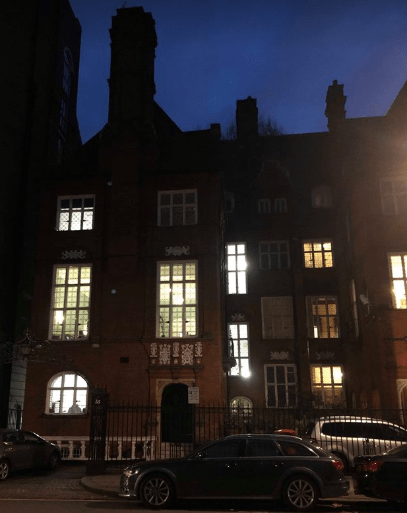
Screen Shot 2018-12-11 at 9.08.45 PM.png                               Photo of Ithaca’s London Center Provided by Weise.

“There’s no CAPS or medical center,” said Weise,”They refer you to a psychiatrist within London or refer you to other sorts of professional help if you need it through the free student international insurance.” Weise hasn’t had to utilize the insurance yet but she said she could see the process of finding places that take the insurance as an added stressor for an already struggling student. However CAPS does offer remote counseling if students reach out to them while abroad.

Junior Michaela Jackson has had a positive experience with the services CAPS provides. She has utilized their sunroom area where sun lamps help those being negatively affected by the change in weather. She has also been to their Anxiety Toolbox workshops which happen every Monday.  From this workshop she learned some tips to keep her stress under control. She is also aware that some of the clubs on campus offer events to help students destress. She said the college itself should be providing more help for stressed out students.

“Overall I feel like IC should implement some different programs to help students, especially during finals,” said Jackson.
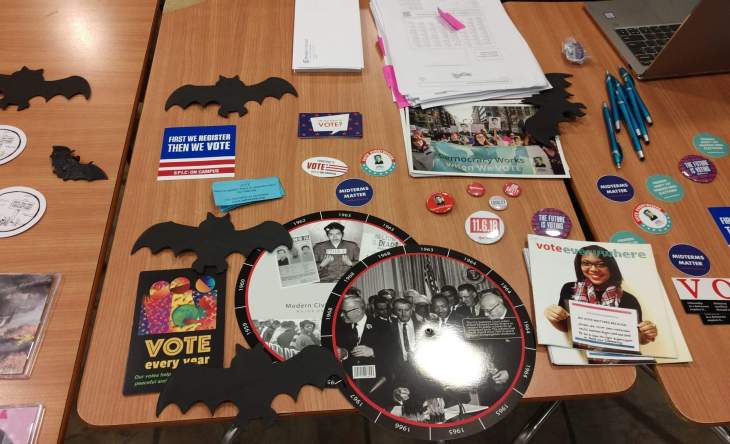
 

Students Vote for Dracula

On October 27th Ithaca College’s Macabre Theatre Ensemble held a benefit concert to raise money for the Andrew Goodman Foundation. The Andrew Goodman Foundation encourages young citizens to vote and be heard. They also help with voter accessibility. Being both the artistic director for Macabre Theater Ensemble and a campus ambassador for the Andrew Goodman Foundation, Alexandria Paul decided to combine the two in one event.

“Vote for Dracula is part of our benefit concert series in which we pick a charity and throw a concert with all students bands”, said Paul. She said that Macabre Theatre Ensemble have been throwing benefit concerts for two years. “We’ve done seven or eight concerts, all for different charities.” Paul explained that since the Andrew Goodman Foundation stresses that young people get out and vote and the midterm elections are coming up soon, Macabre Theatre Ensemble should have a benefit concert for the foundation.

The concert took place at the IC square and featured three bands. Tungsten Lungs performed first and was followed by Leonardo Decapitated and Nick Wayne and the Bat Seeds. The music leaned more towards the sound of punk and at one point the bands were asked to turn the music down but that didn’t stop the event or discourage the bands from performing. Students could donate money, buy Macabre themed stickers, and ask Alexandria Paul voting related questions.

received_1839153939539375

“I don’t think voting is the end all be all of your civic duty,” Jake Sullivan explained. As concert chair for Macabre Theatre Ensemble, Sullivan has been a part of their benefit concerts both behind the scenes and on the stage. For this concert, Sullivan was the guitarist in Nick Wayne and the Bat Seeds and although their lead singer jokingly shouted, “Don’t bloody vote,” during their set, Sullivan said that voting is important but continuing to fight for the causes you believe in no matter the outcome of the election is what’s most important.

Poor Sleep, Poor Health

  In 2017 The Observer released an article titled “Sleep should be prescribed”: what those late nights out could be costing you. In the article, sleep scientist Matthew Walker explained the  harmful effects of lack of sleep. Killer cells attack the cancer cells in your body and after a night of under six hours sleep, these cells drop by 70 percent. Just one bad night of sleep has already increased your chances of getting cancer. Driving after a night of less than five hours of sleep makes you 4.3 times more likely to crash. Many nights of little to no sleep is linked to cancer, Alzheimer’s disease, diabetes, obesity and poor mental health. Sleep is a necessity for survival. So why do so many of us have trouble sleeping?

Walker cites light and technology in the article as reasons we can’t sleep and also said anxiety “plays a part,” because as a society we are, “lonelier, more depressed.” Alcohol and caffeine also negatively impact sleep. As it turns out, a lot of what you eat and when you eat it impacts sleep. Inadequate sleep decreases leptin, which tells your body you are full, and increases ghrelin which tells your body you are hungry.

Dr. Farley runs the Farley Neuro-Biomedicine Health System. Part of how he helps clients is by telling them what they should and shouldn’t be eating and how that helps their health. He stresses eating six times a day and having a meal 30 minutes before you go to sleep and within 30 minutes of waking up to fight blood sugar spikes.

“All of your neurotransmitters are dependent on stable blood sugar,” said Farley. When you don’t eat before bed and soon after waking up, you make your blood sugar unstable. This leads to your body releasing cortisol, the stress hormone. Cortisol going up means melatonin going down. Low melatonin means a hard time falling asleep.

“Lack of sleep is a major physical stressor,” said Farley, “Every cell in your body can only heal when you shut down the system and you sleep.”

A person needs four to five 90 minute sleep cycles to achieve all the benefits of sleep. Not sleeping properly, not eating properly, and spikes in blood sugar are all stressors on the body. All three are weakening your body at once. Fixing your sleep may not be as simple as setting a bedtime routine and sticking to it. You may need a meal routine as well. Dr. Farley explained that the meal you eat before going to sleep should not be a carbohydrate and to stay away from fruit before bed. Instead, eat proteins. Snacks such as peanut butter on celery are better to eat before bed.

“Your sleep will influence your ability to manage life because if you’re not getting enough sleep it acts as a physical stressor on you and it breaks you down,”said Farley. According to Farley, lack of sleep is “almost as damaging as major mental emotional stress.”

Professor Shamsi Monfared teaches in Ithaca College’s department of exercise and sport sciences. She said that when an athlete has trouble sleeping, their mental coaches may teach athletes to reframe their perception and consider competing through lack of sleep as a challenge. But when lack of sleep is chronic, there are physiological and cognitive repercussions like fatigue and mental exhaustion.

“Lack of sleep could hurt their cognitive skills, for example anticipation, decision making, working memory and attention,” said Monfared. This isn’t just exclusive to athletes, however. The average person’s cognitive skills, whether they are active or not, faces the same consequences.